Rethinking AI Data Centers: What Could the Next Generation Look Like?
AI's water headlines are aimed at the wrong target. Water is just a transport medium, heat is the real problem. Here's what an AI data center could look like if you designed it from scratch today, using technology that already exists.

AI & Web Consultant · August 2, 2026
Ask anyone worried about AI's environmental footprint what the problem is, and they'll say water. Data centers are draining aquifers. AI is drinking towns dry. It's the headline that keeps writing itself.
That framing isn't wrong. It's just aimed at the wrong target. Water isn't the problem. Water is one answer to the actual problem, which is heat.
Every GPU in every AI data center on the planet is, underneath the matrix multiplication, an extremely expensive space heater. Almost all the electricity that goes into a rack comes back out as heat. The real engineering question was never "how do we cool AI." It's "how do we move an enormous, continuous amount of heat away from a small, extremely hot place, without wasting the energy or the water it takes to do it."
I'm not an engineer in this specific field, and this isn't an article claiming to have solved anything. It's an attempt to think through the question properly: if you were designing an AI data center today, using only technology that already exists or is actively being researched, what would you actually build?
Why Today's Data Centers Drink So Much Water
Most large data centers cool themselves with some version of evaporative cooling. Warm water is sprayed or trickled through a cooling tower, some of it evaporates, and evaporation pulls heat out of the water that's left behind. It's the same principle as sweating. It works, it's cheap, and it's been the industry default for decades.
The catch is the word "evaporates." That water doesn't come back. It leaves the system as vapor, which means the facility has to keep pulling in fresh water to replace it, day after day, for as long as the servers run.
This is worth separating into two different ideas that get blurred together in most headlines:
Water withdrawal is water borrowed and returned, like pulling from a river to cool something and sending it back downstream, warmer but still there.
Water consumption is water that leaves the local system entirely, mostly through evaporation, and has to be replaced from somewhere.
Evaporative cooling is a consumption system. That's exactly why it becomes a flashpoint in places where water is already scarce, and exactly why a large AI campus proposed near a drought-prone town draws so much local opposition. It isn't that the facility is doing something exotic. It's borrowing from a shared, finite local resource, continuously, for its entire operating life.
Heat Doesn't Disappear. It Only Moves.
This is the one idea the rest of this article builds on, so it's worth being explicit about it: heat cannot be destroyed. It can only be moved from somewhere hotter to somewhere colder, and moving it always costs energy.
A GPU gets hot. That heat gets carried into water. The water gets carried into air. The air eventually releases it into the atmosphere. At every step, something is "cooling" something else, but really, all that's happening is heat being relocated, one step further away from the chip.
"Cooling" is a polite word for "relocating." The moment you think of it that way, the actual design question changes from "how do we get rid of the heat" to "where is the smartest place to put it, and how cheaply can we get it there?"
That reframing matters, because "the smartest place to put it" doesn't have to be the atmosphere by default.
If You Designed an AI Campus From Scratch
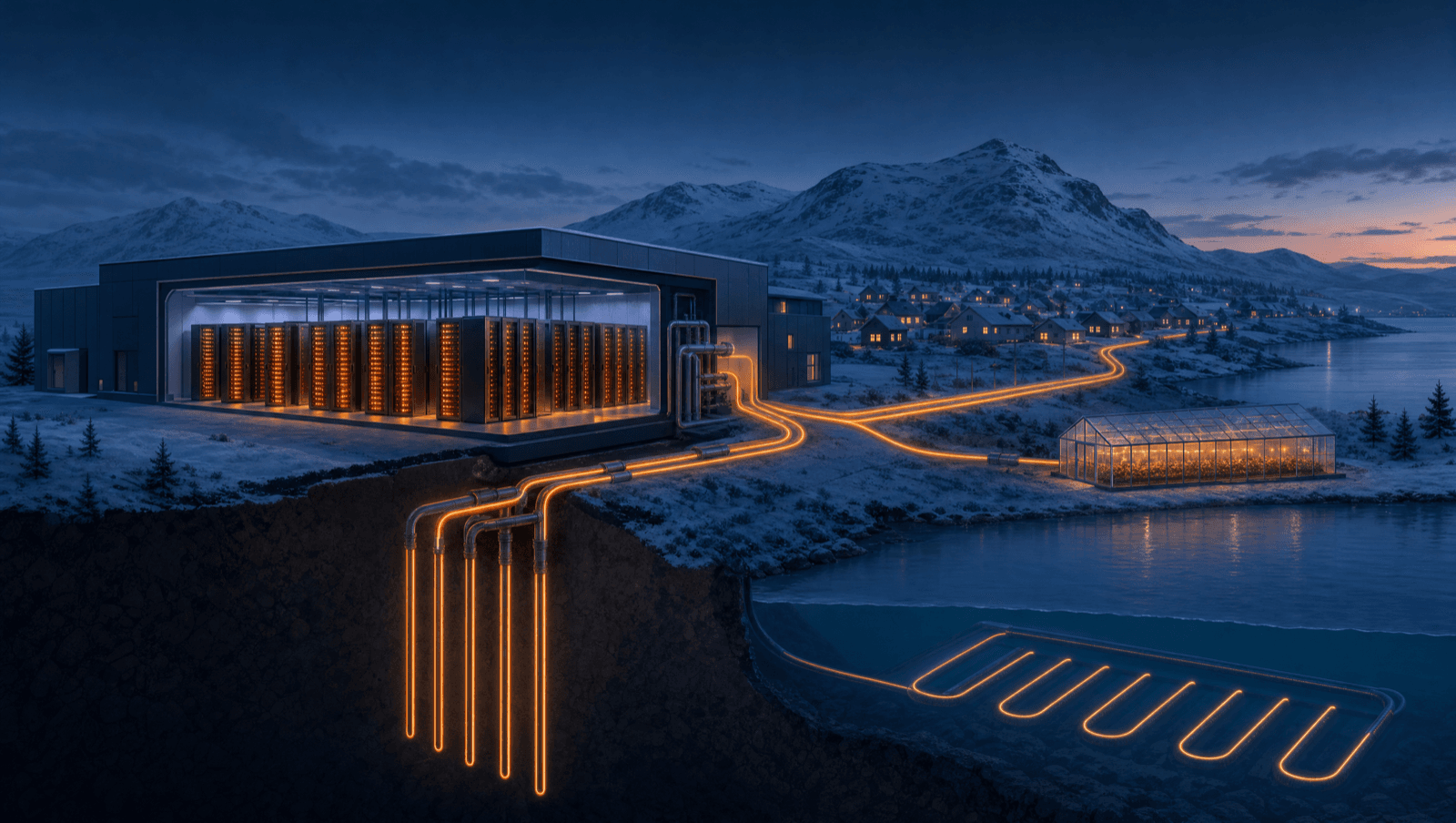
Here's where it gets genuinely interesting. If you had no legacy infrastructure and no assumptions to defend, a modern AI campus could route heat through several stages, each one choosing the cheapest, least wasteful option available at that moment, rather than defaulting to "spray water and evaporate it."
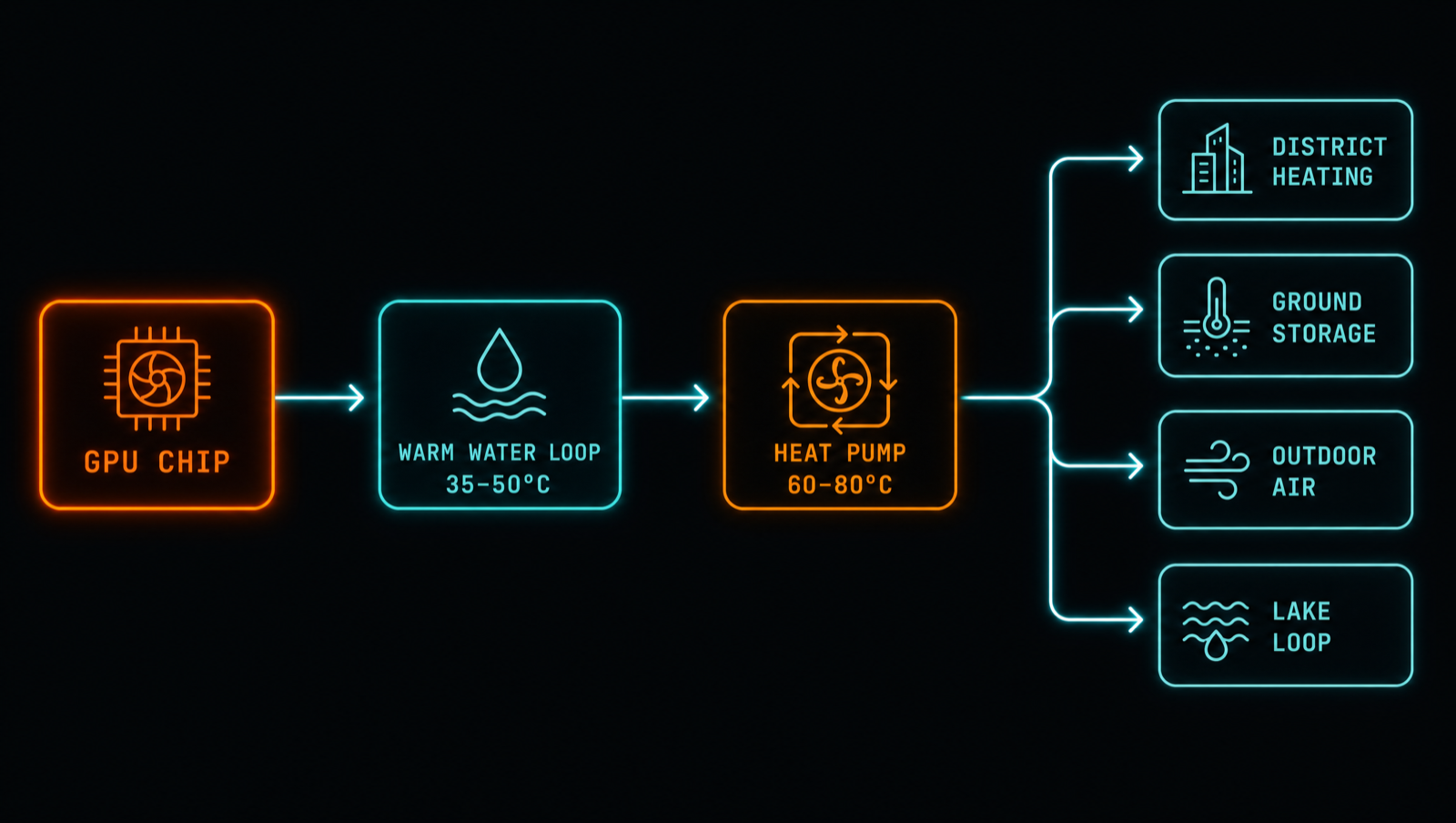
Stage one: a sealed water loop straight to the chip. A mix of water and glycol runs through cold plates mounted directly on the GPUs and CPUs. It never touches groundwater, never touches a lake, and normally never evaporates, it's reused continuously in a closed circuit. It leaves the chips warm, somewhere in the 35-50°C range depending on the design. Direct-to-chip liquid cooling along these lines is already in real production use in some facilities today, it isn't speculative.
Stage two: a heat pump. This is the least intuitive part for most people, so it's worth slowing down on. A heat pump doesn't create cold. It moves heat from one place to a hotter place, using a refrigerant that evaporates at low pressure, gets compressed, releases heat at a higher temperature, and condenses again in a sealed loop.
How efficiently it does that depends almost entirely on something called the temperature lift, the gap between where the heat starts and how hot you need it to end up. Moving heat from 40°C to 65°C is a much smaller lift than moving it from 20°C to 80°C, and a smaller lift means far less electricity spent per unit of heat moved.
This is exactly why the warm-water chip loop from stage one matters so much. It hands the heat pump a warmer starting point than air-cooling ever could, which makes the whole system more efficient at the one step that would otherwise be the most expensive.
Stage three: somewhere useful to put the heat. Once a heat pump has raised that waste heat to somewhere around 60-80°C, it stops being waste and starts being a product. This isn't hypothetical, several data centers in the Nordics already pipe their waste heat directly into local district heating networks that warm homes and buildings nearby. Instead of spending electricity purely to throw heat away, the facility spends a bit of electricity to upgrade low-grade waste heat into something a neighborhood can actually use.
Stage four: the ground, as a buffer, not a dumping ground. Kilometres of closed pipe buried in boreholes can carry heat into the soil, the same principle as a ground-source heat pump, just at a much larger scale. The problem is scale itself. A 100-megawatt data centre produces something in the rough neighbourhood of 100 megawatts of continuous heat, roughly enough to heat tens of thousands of homes depending on climate and building efficiency. Dump that into the ground continuously and the soil around the pipes will keep warming unless the borehole field is enormous, the system alternates between injecting and extracting heat seasonally, or most of that heat gets used elsewhere first. Seasonal underground thermal storage, storing winter cold to offset summer cooling demand, is an active area of research specifically because of this limitation, not despite it.
Stage five: the outdoor air, whenever it's cold enough to help for free. On a cold day, heat can be rejected straight into outdoor air through dry coolers, no water and almost no extra energy required. This is exactly why climate matters so much for where these facilities get built, a Nordic winter is doing engineering work that a data centre in a hot, dry climate simply doesn't get for free.
Stage six: a lake or the sea, carefully. A closed loop of pipe submerged underwater can reject heat without a single litre of lake or sea water ever entering the facility, no chemicals discharged, no organisms drawn through an intake. It's a smaller-capacity option than pumping water directly through a heat exchanger and back out again, but that direct, open-loop approach carries real ecological risk: warmer discharge water holds less dissolved oxygen, and local species with narrow temperature tolerances can be affected near the outflow. The comparison people sometimes reach for here, that life thrives around deep-sea hydrothermal vents, so warm water can't be that bad, misses the point. Vent ecosystems evolved specifically for those conditions over long timescales, in a vast, well-mixed ocean. A shallow lake with far less volume and far less mixing capacity, absorbing continuous heat from one fixed point for decades, is a completely different situation.
Stage seven: reclaimed water, kept in its own loop, only for emergencies. Treated wastewater, rainwater, or water unsuitable for drinking can absolutely help with peak cooling demand, but it should stay physically separate from the clean internal loops, exchanging heat through a plate heat exchanger rather than mixing directly with refrigerant or chip-cooling water. Refrigerant circuits need tightly controlled chemistry and pressure. Dirty water introduces corrosion, scaling, and biological growth that precision cooling hardware isn't built to tolerate.
Put together, the system behaves less like one clever invention and more like a control problem: on any given hour, pick whichever heat destination is cheapest and lowest-impact, and only reach for drinking water as a last resort, not a default.
Could Better Hardware Make Most of This Unnecessary?
There's a version of this problem that never needs a heat pump, a lake loop, or a borehole field at all: generate less heat in the first place. Every watt saved inside the chip is a watt that never has to be moved by anything downstream, which is almost always cheaper than any amount of cooling engineering.
This is where synthetic diamond gets genuinely interesting, and it's worth being precise about what stage this technology is actually at. Diamond has one of the highest thermal conductivities of any known bulk material, roughly five times higher than copper. Researchers are actively developing thin, lab-grown (CVD) diamond layers designed to sit directly on or near chips, pulling heat away from tiny hotspots faster than existing materials can. This is real, active research, not science fiction, but it's still mostly at the research and early-commercialization stage. The open questions are manufacturing cost, integration with existing chip packaging, and producing it at the scale a hyperscale campus would need, not whether the physics works.
To be clear about what this would and wouldn't do: better chip-level heat spreading doesn't replace the water and heat-pump loops described above. It reduces how much heat concentrates in hotspots before it even reaches those loops, which can shrink how aggressive the downstream cooling system needs to be. History has a pattern worth noting here: efficiency gains upstream have repeatedly reduced the need for brute-force infrastructure downstream, more efficient lighting reduced the cooling load buildings needed before it reduced anyone's electricity bill directly. AI hardware may follow the same arc: more efficient chips and more efficient models both mean less heat generated per unit of useful computation, which is a cheaper win than any cooling technology could ever be.
Nature Already Moves Heat Around at Enormous Scale
None of this is really a new problem. Nature has been moving large quantities of heat around efficiently for a very long time, and a few examples are genuinely instructive rather than just poetic.
Deep soil and cave systems stay at a remarkably stable temperature year-round, which is exactly the property ground-source systems try to exploit. Large bodies of water have enormous thermal mass and mix slowly, which is why lake and sea loops can work as heat sinks in the first place. Termite mounds use passive convection, warm air rising through internal channels and pulling cooler air in behind it, to keep internal temperatures stable without anything resembling a fan or a compressor, a genuinely well-studied example in biomimetic architecture.
None of this means data centers should try to literally copy a termite mound. It means nature already runs continuous, large-scale heat-management systems for free, using temperature gradients, phase changes, and slow mixing, and there's no reason engineered systems can't borrow the same underlying principles instead of relying on one brute-force method.
What If Heat Stopped Being Treated as Waste?
This is the part of the thought experiment I find most interesting, because it changes the entire emotional framing of the problem.
The default mental model looks like this: electricity goes in, computation happens, heat comes out, and the heat gets thrown away. Waste in, waste out.
But once a heat pump has lifted that waste heat to a genuinely useful temperature, there's no fundamental reason it has to end at "waste" at all. It can end at homes, through a district heating network. It can end at greenhouses, extending a growing season through a cold climate. It can end at fish farms, which need stable warm water year-round. It can end at industrial processes that need drying or preheating and currently burn fuel to get it.
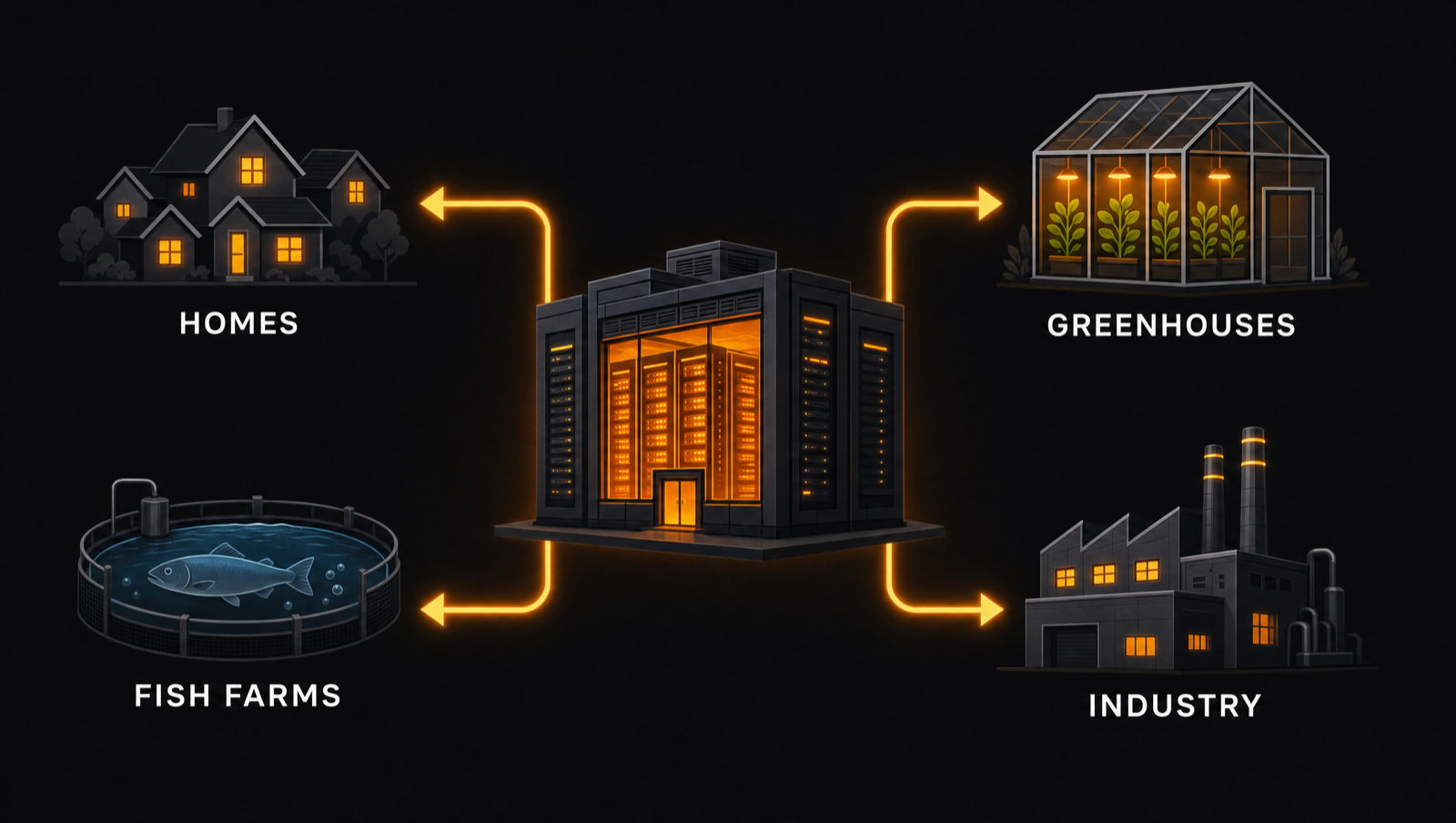
Treated this way, a data center stops looking purely like a consumer of electricity and water, and starts looking like a local energy asset that happens to also run AI workloads. That's a genuinely different way to justify building one, and a genuinely different relationship with the community around it.
What Still Isn't Solved
It would be dishonest to end this without naming the parts that don't have a clean answer yet.
Economics. A facility with seven heat destinations and a control system smart enough to pick the cheapest one each hour costs far more upfront than a straightforward cooling tower. That premium is much easier to justify when there's a district heating customer or another buyer for the heat lined up in advance, and much harder to justify without one.
Scale mismatch. No single environmental sink, not the ground, not a lake, not a district heating network, can absorb a hyperscale campus's full continuous heat output forever on its own. Real designs need several destinations plus redundancy, not one elegant final answer, because the facility can't shut down just because the neighborhood stopped needing heat for the summer or the ground storage hit capacity.
Reliability. Whatever system gets built has to run every hour of every day, through every season, regardless of which heat sink is temporarily unavailable. That need for redundancy is itself a cost most simple designs don't have to carry.
There's no silver bullet sitting in this article, and there isn't one sitting anywhere else either. That's not a weakness in the thinking, it's just an honest description of where the engineering actually is.
A Different Question to End On
Almost everyone working on this problem is asking, "how do we cool AI more efficiently?" That's a fine question. But it might not be the most useful one.
A better question might be: what would it take to stop treating the heat AI produces as something to get rid of, and start treating it as something to design around, from the very first sketch of the building? Not bolted on afterward as an offset or a PR line, but built in from day one as one of the things the facility is actually for.
Nobody has fully answered that yet. But every piece required to take a real run at it, warm-water chip cooling, heat pumps, district heating, ground storage, better materials, already exists today, in production or in active research. The gap isn't invention. It's someone deciding to combine what already exists differently than the industry defaults to.
FAQ
Is AI's water usage actually a real problem, or is it overstated? It's real, but it's concentrated. The impact depends heavily on the cooling method and the local water situation, evaporative cooling in a water-stressed region is a genuinely different problem than the same facility built somewhere with abundant water and a cold climate. The water figures making headlines are usually about consumption (water that evaporates and doesn't return), not withdrawal (water that's borrowed and returned).
Do heat pumps use more energy than they save? No, but they're not free either. A well-designed heat pump moves several units of heat for every unit of electricity it consumes, and that ratio gets better the smaller the temperature lift is. That's precisely why pairing them with warm-water chip cooling, which gives them a warmer starting point, matters so much.
Is diamond cooling something that exists in products today? Not at scale. It's an active, credible area of research into chip-level heat spreading, not a deployed data center cooling technology. It's worth watching, not something to expect in commercial systems imminently.
Could a data center really heat an entire town? At the scale of a large facility, the raw heat output is genuinely large enough to matter to a district heating network, and this is already happening in parts of the Nordics today. Whether it's practical for a specific site depends on distance to the network, the local heating infrastructure, and whether the economics line up, not on whether the physics works.
This piece is an exploration of existing and emerging technology, not a claim to have solved data center cooling. Where it discusses commercial systems, that's noted. Where it discusses active research, that's noted too. Where it's speculation about how the pieces could fit together, that's the whole point of the exercise.
Want help implementing this?
I help B2B companies implement AI solutions that actually move metrics, not science projects. If this guide resonated, let's talk about what it looks like for your business.
Get in touch